
Building Arapaho, Cheyenne and Niwot Relationships Videos
A supporting proof-of-method page linking to video conversations from NiwotLivingHistory.org with Southern Arapaho Elder Fred Mosqueda and Southern Cheyenne Elder Chester Whiteman.
Case Study: At A Glance
- Challenge
- Short articles and signage cannot carry the full voice of Tribal Elders. Communities needed to hear Arapaho and Cheyenne perspectives in their own words.
- Role
- Phillip Yates coordinated, recorded, and published video conversations with Southern Arapaho Elder Fred Mosqueda and Southern Cheyenne Elder Chester Whiteman through NiwotLivingHistory.org.
- Work
- Conversation planning, hospitality, on-site coordination, video capture, editing, publishing, and ongoing public communication tied to the broader Niwot relationship-building work.
- Outcome
- A publicly accessible video archive that preserves Elder voices, deepens community understanding, and supports historical storytelling beyond a single event.
Role note: These videos should be framed as public-history conversations connected to NiwotLivingHistory.org and community relationship-building. CenterSignal should not present the videos as consultation, Tribal authorization, or Native-led representation.
Summary
These video conversations are part of NiwotLivingHistory.org, an independent public-history and relationship-building platform created by Phillip Yates. They are included here as a CenterSignal proof-of-method resource because they show how one community gathering can become lasting public education through video documentation, Elder guidance, ethical framing, and accessible storytelling.
The page points visitors back to Niwot Living History for the full context while helping CenterSignal demonstrate its method: turning complex history, public memory, and relationship-building into useful public learning.
Intro
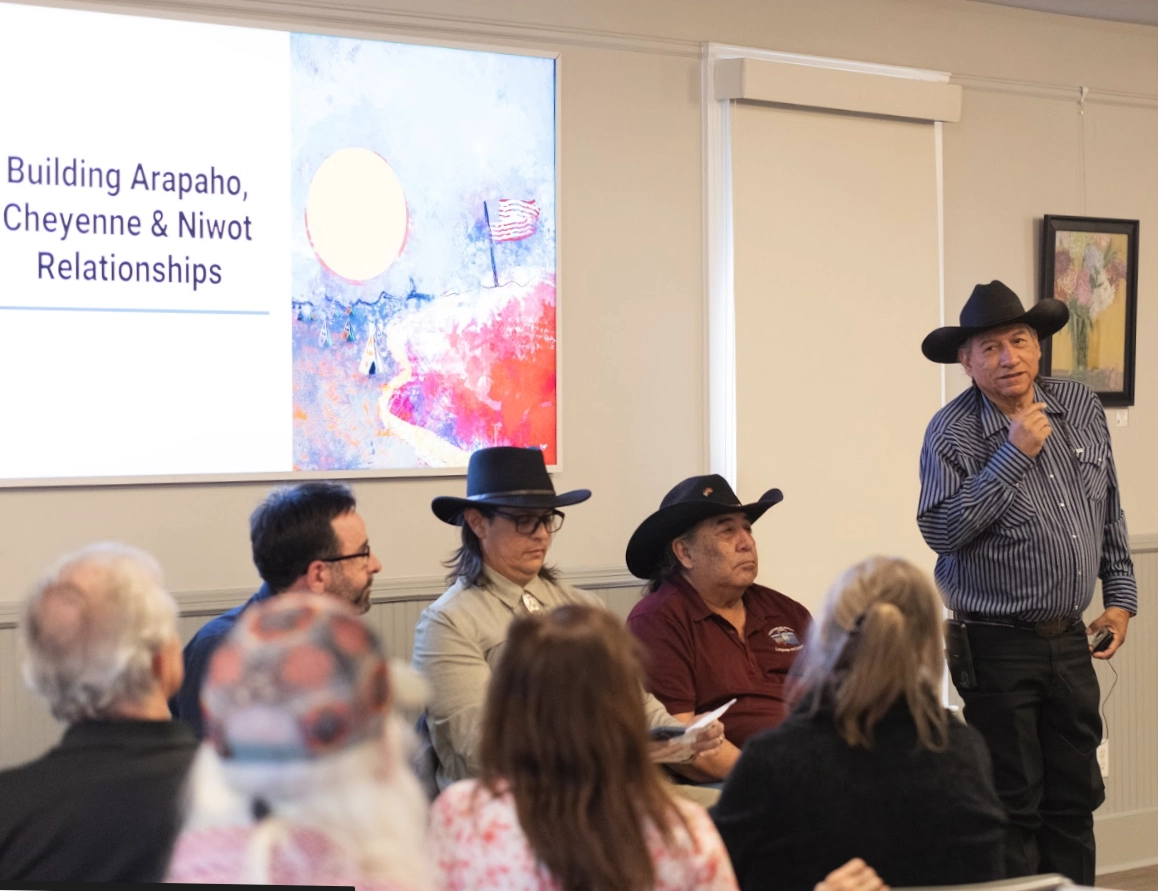
In March 2025, Southern Arapaho Elder Fred Mosqueda and Southern Cheyenne Elder Chester Whiteman joined Niwot community members for *Building Arapaho, Cheyenne, and Niwot Relationships*.
The gathering did not end when the room emptied.
The video conversations became a public learning resource on NiwotLivingHistory.org, helping people continue learning about Chief Nowoo3, Neva, Snake Woman, the Sand Creek Massacre, relationship-building, land acknowledgments, Mount Blue Sky, Traditional Ecological Knowledge, and Arapaho and Cheyenne languages.
CenterSignal includes this page as a proof-of-method resource. It shows how public history, video documentation, careful summaries, links, transcripts, and ethical boundaries can help a community carry learning forward.
Ethical Boundary
These conversations are part of NiwotLivingHistory.org. CenterSignal does not speak for Tribal Nations, Native communities, Elders, cultural authorities, or Tribal Representatives.
Video documentation for the March 2025 community-led event was created by Jason Houston and Dewi Sungai Marquis-Houston with Eight16Creative. CenterSignal frames the page as a public education and communication architecture example, not as a claim to be the video production company.
For full context and any available transcripts, visit Niwot Living History Elder Conversations and Building Arapaho, Cheyenne and Niwot Relationships.
Video Conversations
01 · Nowoo3, Neva & Snake Woman
Southern Arapaho Elder Fred Mosqueda shares the story of Chief Nowoo3, his brother Neva, and their older sister Mahom, also known as Snake Woman, whose family survived the Sand Creek Massacre. He explains how Mahom's daughters used their English-language skills as interpreters during treaty negotiations that ultimately forced the Arapaho People to Oklahoma.
02 · Legacy of the Sand Creek Massacre
Fred Mosqueda and Chester Whiteman reflect on the Sand Creek Massacre, Chief Nowoo3's death from his injuries, and the false "Indian Uprising" narrative repeated in Boulder County. They recount how Cheyenne and Arapaho leaders were denied an opportunity to negotiate peace and emphasize the enduring resilience of their peoples.
03 · Perspectives of Relationship Building
Fred Mosqueda and Chester Whiteman share their experiences building relationships with local governments, nonprofits, and other organizations across Colorado. They explain that truthful storytelling, mutual effort, and respect are necessary for healing and moving forward together.
04 · Go Beyond a Land Acknowledgment
Fred Mosqueda and Chester Whiteman discuss how communities can move beyond land acknowledgments by bringing Tribal Nations to the table and recognizing the knowledge they contribute. They call for tangible, face-to-face collaboration that creates shared benefits and turns passive statements into action.
05 · What Can We Do Together?
Fred Mosqueda and Chester Whiteman discuss co-stewardship, efforts to bring buffalo back to Boulder County, and the Cheyenne and Arapaho Tribes' desire to return to Colorado. They describe that homecoming as a collaborative opportunity grounded in strong relationships and the question, "What can we do together?"
06 · Naming Mount Blue Sky
Fred Mosqueda and Chester Whiteman recount their collaboration to rename Mount Evans as Mount Blue Sky. They describe uniting Tribal Nations and government agencies around a name intended to honor both Arapaho and Cheyenne people without causing further harm.
07 · Traditional Ecological Knowledge
Fred Mosqueda and Chester Whiteman discuss Traditional Ecological Knowledge and how their ancestors' understanding of plants, animals, water, and natural systems remains vital today.
08 · Arapaho and Cheyenne Languages
Fred Mosqueda and Chester Whiteman discuss efforts to preserve Arapaho and Cheyenne languages and teach them to new generations, emphasizing that these living oral languages are best sustained through face-to-face conversation.
Related
Start With The Place
Have a project, public story, or community process shaped by land, memory, history, or relationships?
CenterSignal can help you understand what the place carries, prepare the people leading the work, and communicate meaningful history with care, clarity, and responsibility.